
The blockchain is an undeniably ingenious invention – the brainchild of a person or group of people known by the pseudonym, Satoshi Nakamoto. But since then, it has evolved into something greater, and the main question every single person is asking is: What is Blockchain?
By allowing digital information to be distributed but not copied, blockchain technology created the backbone of a new type of internet. Originally devised for the digital currency, Bitcoin, the tech community is now finding other potential uses for the technology.
Bitcoin has been called “digital gold,” and for a good reason. To date, the total value of the currency is close to $9 billion US. And blockchains can make other types of digital value. Like the internet (or your car), you don’t need to know how the blockchain works to use it. However, having a basic knowledge of this new technology shows why it’s considered revolutionary. So, we hope you enjoy this, what is Blockchain guide.
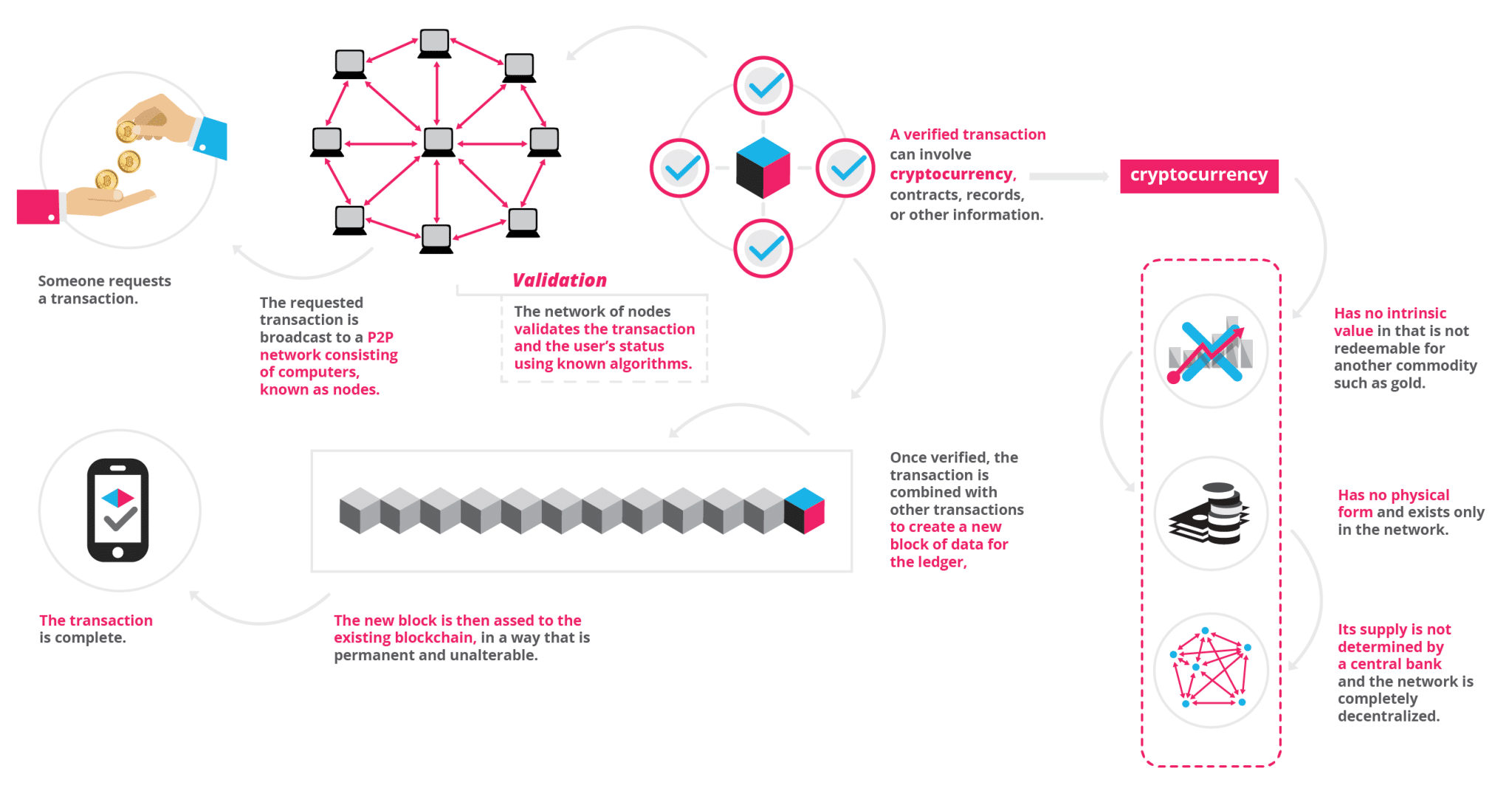
A distributed database
Picture a spreadsheet that is duplicated thousands of times across a network of computers. Then imagine that this network is designed to regularly update this spreadsheet and you have a basic understanding of the blockchain.
Information held on a blockchain exists as a shared — and continually reconciled — database. This is a way of using the network that has obvious benefits. The blockchain database isn’t stored in any single location, meaning the records it keeps are truly public and easily verifiable. No centralized version of this information exists for a hacker to corrupt. Hosted by millions of computers simultaneously, its data is accessible to anyone on the internet.
To go in deeper with the Google spreadsheet analogy, I would like you to read this piece from a blockchain specialist.
Blockchain as Google Docs
Blockchain Durability and robustness
Blockchain technology is like the internet in that it has a built-in robustness. By storing blocks of information that are identical across its network, the blockchain cannot:
- Be controlled by any single entity.
- Has no single point of failure.
Bitcoin was invented in 2008. Since that time, the Bitcoin blockchain has operated without significant disruption. (To date, any of problems associated with Bitcoin have been due to hacking or mismanagement. In other words, these problems come from bad intention and human error, not flaws in the underlying concepts.)
The internet itself has proven to be durable for almost 30 years. It’s a track record that bodes well for blockchain technology as it continues to be developed.
Transparent and incorruptible
The blockchain network lives in a state of consensus, one that automatically checks in with itself every ten minutes. A kind of self-auditing ecosystem of a digital value, the network reconciles every transaction that happens in ten-minute intervals. Each group of these transactions is referred to as a “block”. Two important properties result from this:
- Transparency
data is embedded within the network as a whole, by definition it is public. - It cannot be corrupted
altering any unit of information on the blockchain would mean using a huge amount of computing power to override the entire network.
In theory, this could be possible. In practice, it’s unlikely to happen. Taking control of the system to capture Bitcoins, for instance, would also have the effect of destroying their value.
A network of nodes
A network of so-called computing “nodes” make up the blockchain.
Node
(computer connected to the blockchain network using a client that performs the task of validating and relaying transactions) gets a copy of the blockchain, which gets downloaded automatically upon joining the blockchain network
Together they create a powerful second-level network, a wholly different vision for how the internet can function.
Every node is an “administrator” of the blockchain, and joins the network voluntarily (in this sense, the network is decentralized). However, each one has an incentive for participating in the network: the chance of winning Bitcoins.
Nodes are said to be “mining” Bitcoin, but the term is something of a misnomer. In fact, each one is competing to win Bitcoins by solving computational puzzles. Bitcoin was the raison d’etre of the blockchain as it was originally conceived. It’s now recognized to be only the first of many potential applications of the technology.
There are an estimated 700 Bitcoin-like cryptocurrencies (exchangeable value tokens) already available. As well, a range of other potential adaptations of the original blockchain concept are currently active, or in development.
The idea of decentralization
By design, the blockchain is a decentralized technology.
Anything that happens on it is a function of the network as a whole. Some important implications stem from this. By creating a new way to verify transactions aspects of traditional commerce could become unnecessary. Stock market trades become almost simultaneous on the blockchain, for instance — or it could make types of record keeping, like a land registry, fully public. And decentralization is already a reality.
A global network of computers uses blockchain technology to jointly manage the database that records Bitcoin transactions. That is, Bitcoin is managed by its network, and not any one central authority. Decentralization means the network operates on a user-to-user (or peer-to-peer) basis. The forms of mass collaboration this makes possible are just beginning to be investigated.
Who will use the blockchain?
As web infrastructure, you don’t need to know about the blockchain for it to be useful in your life.
Currently, finance offers the strongest use cases for the technology. International remittances, for instance. The World Bank estimates that over $430 billion US in money transfers were sent in 2015. And at the moment there is a high demand for blockchain developers.
The blockchain potentially cuts out the middleman for these types of transactions. Personal computing became accessible to the general public with the invention of the Graphical User Interface (GUI), which took the form of a “desktop”. Similarly, the most common GUI devised for the blockchain are the so-called “wallet” applications, which people use to buy things with Bitcoin, and store it along with other cryptocurrencies.
Transactions online are closely connected to the processes of identity verification. It is easy to imagine that wallet apps will transform in the coming years to include other types of identity management.
The Blockchain & Enhanced security
By storing data across its network, the blockchain eliminates the risks that come with data being held centrally.
Its network lacks centralized points of vulnerability that computer hackers can exploit. Today’s internet has security problems that are familiar to everyone. We all rely on the “username/password” system to protect our identity and assets online. Blockchain security methods use encryption technology.
The basis for this are the so-called public and private “keys”. A “public key” (a long, randomly-generated string of numbers) is a users’ address on the blockchain. Bitcoins sent across the network gets recorded as belonging to that address. The “private key” is like a password that gives its owner access to their Bitcoin or other digital assets. Store your data on the blockchain and it is incorruptible. This is true, although protecting your digital assets will also require safeguarding of your private key by printing it out, creating what’s referred to as a paper wallet.

A second-level network
With blockchain technology, the web gains a new layer of functionality.
Already, users can transact directly with one another — Bitcoin transactions in 2016 averaged over $200,000 US per day. With the added security brought by the blockchain new internet business are on track to unbundle the traditional institutions of finance.
Goldman Sachs believes that blockchain technology holds great potential especially to optimize clearing and settlements, and could represent global savings of up to $6bn per year.


0 comments:
Post a Comment